A comprehensive 7on7 flag football playbook, often in PDF format, is crucial for strategic gameplay, detailing formations, routes, and defensive schemes for team success.
What is 7on7 Flag Football?
7on7 flag football is a non-contact version of the sport, emphasizing passing skills and strategic play. Unlike traditional football, there’s no blocking or tackling; defenders win by “pulling a flag” from the ball carrier. This format typically involves seven players per side, focusing heavily on quarterback-receiver combinations and complex route trees.
A well-designed 7on7 flag football playbook PDF becomes essential for organizing these strategies. It outlines offensive and defensive schemes, detailing route concepts, coverage assignments, and special team plays; Teams utilize these playbooks to practice and execute coordinated plays, maximizing their offensive efficiency and defensive effectiveness in this fast-paced, skill-based game.
Why Use a Playbook?
Employing a 7on7 flag football playbook PDF is paramount for several reasons. It fosters consistency in execution, ensuring all players understand their roles and responsibilities within each play. A playbook streamlines communication, reducing pre-snap confusion and enabling quicker adjustments during games.
Furthermore, a detailed playbook facilitates practice efficiency, allowing coaches to focus on refining technique rather than explaining basic concepts repeatedly. It also promotes strategic depth, enabling teams to adapt to various defensive looks and exploit opponent weaknesses. A well-structured PDF playbook serves as a central repository of knowledge, improving team cohesion and maximizing competitive advantage.

Offensive Playbook Essentials
A 7on7 offensive playbook PDF centers on passing concepts, route combinations, and quarterback reads, maximizing aerial attack efficiency and exploiting defensive vulnerabilities.

Passing Concepts
Within a 7on7 flag football playbook PDF, passing concepts form the core of the offense. These are categorized by route depth and intended purpose. Quick game concepts – slants, outs, and hitches – prioritize rapid throws for consistent gains and beating pressure. Intermediate routes, like digs, curls, and crossing routes, demand timing and accuracy, attacking the middle of the field.
Deep threats, including go routes and post-O’s, stretch the defense vertically, creating one-on-one opportunities. Playbooks detail route trees, receiver responsibilities, and quarterback progressions for each concept. Effective playbooks also include variations and adjustments based on defensive looks, ensuring adaptability and maximizing offensive potential. Diagrams and clear explanations are essential for player comprehension.
Quick Game – Slants, Outs, and Hitches
A 7on7 flag football playbook PDF dedicates significant attention to the quick game. Slants are short, inside routes designed for quick completions and yards after catch. Outs are routes breaking towards the sideline, ideal for spacing and forcing defenders to cover ground. Hitches involve a quick stop route, offering a reliable target for the quarterback under pressure.
Playbooks illustrate precise route depths, receiver techniques (e.g., creating separation), and quarterback footwork for each route. Variations, like slant-flat combinations, are also detailed. The quick game’s success relies on timing and accuracy, making repetition in practice crucial. Diagrams within the PDF clearly show route paths and potential reads for the QB.
Intermediate Routes – Digs, Comps, and Posts
A well-structured 7on7 flag football playbook PDF extensively covers intermediate routes. Digs (or “in cuts”) are routes that break sharply inward, attacking the middle of the field. Comps (completion routes) are designed for consistent gains, often featuring a curl or hook. Posts involve a receiver running directly towards the goalposts, stretching the defense vertically.
The playbook PDF will detail route depths (typically 10-15 yards), receiver techniques for creating separation, and quarterback progression reads. Playbooks often include variations like post-corner combinations. Mastering these routes requires precise timing and accurate throws. Diagrams illustrate route trees and potential coverage beaters, aiding in practice execution.
Deep Threats – Go Routes and Post-O’s
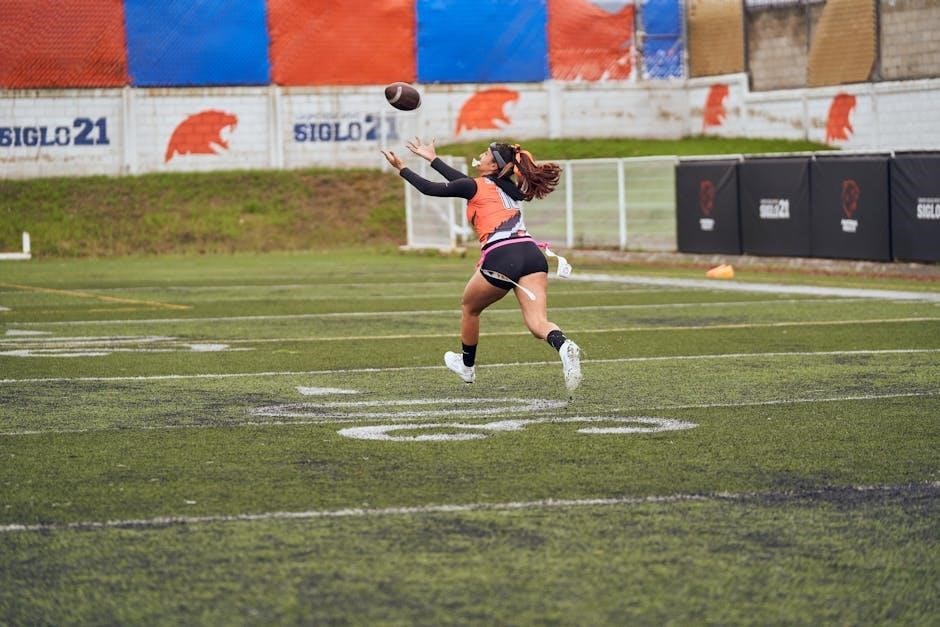
A comprehensive 7on7 flag football playbook PDF dedicates significant attention to deep passing concepts. Go routes (or “fly routes”) are straight vertical routes designed to stretch the field and exploit single coverage. Post-O’s (post-overs) combine a post route with an over route, creating route conflicts for defenders.
The playbook PDF will illustrate proper receiver releases, quarterback throwing mechanics for deep accuracy, and safety help responsibilities. Route diagrams will showcase route combinations and potential adjustments based on defensive alignment. Practice drills focusing on timing and ball tracking are essential. Successful deep plays often rely on pre-snap reads and exploiting defensive weaknesses.
Running Plays (Limited in 7on7)
While 7on7 flag football emphasizes passing, a well-rounded playbook PDF acknowledges limited running concepts. Draw plays can be effective, initially showing pass protection before handing off to a receiver for a short gain, catching the defense off guard.
QB scrambles, both designed and improvisational, are crucial. The playbook PDF should detail when the QB has the green light to run, emphasizing protecting the flag. Drills focus on QB agility and receiver blocking assignments. These plays aren’t primary, but add unpredictability. The PDF will highlight recognizing defensive pressure and exploiting open space with QB mobility.
Draw Plays
The 7on7 flag football playbook PDF details draw plays as a deceptive tactic. Initially, the offensive line mimics pass protection, luring defenders forward. The quarterback then hands the ball off to a receiver, typically a quick slot or running back type, aiming for a short gain.
Success relies on timing and convincing fake pass reads. The PDF includes diagrams showing receiver routes designed to sell the pass, and blocking schemes to create a lane. Practice emphasizes the handoff exchange and receiver’s ability to find a quick opening. Draw plays are most effective against aggressive pass rushes, exploiting over-pursuit.
QB Scrambles (Designed and Improvisational)
The 7on7 flag football playbook PDF outlines both designed and improvisational QB scramble options. Designed scrambles involve pre-determined running lanes for the quarterback, often built into passing plays as a check-down. These are diagrammed with specific receiver routes to clear space.
Improvisational scrambles rely on the QB’s athleticism and field awareness. The playbook emphasizes keeping eyes downfield while scrambling, looking for open receivers. It also details rules for when to throw the ball away to avoid sacks (flags). Drills focus on quick decision-making, agility, and extending plays while maintaining passing threat.

Defensive Playbook Strategies
A robust 7on7 flag football playbook PDF details defensive formations, coverage schemes (zone & man), and blitz packages to disrupt the offense effectively.
Common Defensive Formations
Within a 7on7 flag football playbook PDF, understanding common defensive formations is paramount. Zone coverage, like 2-Man (two deep safeties, five underneath), 3-Man (three deep defenders), and Cover 4 (four deep defenders), emphasizes area responsibility. These formations aim to prevent big plays and force shorter throws.
Man coverage, including 1-on-1 assignments and aggressive Press Coverage, focuses on disrupting receivers at the line of scrimmage. A well-designed playbook will illustrate the strengths and weaknesses of each formation, detailing player responsibilities and adjustments based on offensive alignment. Diagrams within the PDF are essential for visual clarity, showing proper positioning and coverage rotations. Effective implementation requires consistent practice and communication.
Zone Coverage – 2-Man, 3-Man, and Cover 4
A 7on7 flag football playbook PDF will detail zone coverage variations. 2-Man utilizes two deep safeties, covering deep halves of the field, with five defenders underneath in flat and hook zones. 3-Man employs three deep defenders, offering more flexibility against vertical threats. Cover 4, with four deep defenders, excels at preventing deep passes but can be vulnerable underneath.
The playbook should illustrate each formation’s strengths and weaknesses, outlining defender responsibilities for specific routes. Diagrams are crucial, showing zone boundaries and potential coverage rotations. Effective zone defense relies on communication and disciplined execution, ensuring defenders maintain their assigned areas and react to the quarterback’s reads. Playbook entries should include adjustments for common offensive formations.
Man Coverage – 1-on-1 and Press Coverage
A detailed 7on7 flag football playbook PDF must thoroughly cover man coverage schemes. 1-on-1 coverage assigns each defender to a specific receiver, mirroring their routes. Press Coverage involves defenders lining up close to the receiver at the snap, attempting to disrupt their route with physical contact (within legal limits for flag football).
The playbook should illustrate techniques for jamming receivers, maintaining leverage, and reading route breaks. Diagrams should show proper alignment and potential help responsibilities. Success hinges on defender athleticism, quickness, and the ability to anticipate receiver movements. Playbook entries should detail adjustments for different receiver skill sets and offensive formations, emphasizing communication and individual matchups.
Blitz Packages
A robust 7on7 flag football playbook PDF necessitates a section dedicated to blitz packages, designed to disrupt the offense and generate quick pressure. These packages detail when and how to send extra defenders – beyond the standard four rushers – to attack the quarterback.
The playbook should illustrate various blitz schemes, including Line Blitzes (from defensive linemen) and Corner/Safety Blitzes (disguised pressure from the secondary). Diagrams must clearly show blitzing responsibilities, coverage adjustments by remaining defenders, and potential hot routes for the offense. Effective blitzing requires precise timing, communication, and the ability to adapt to pre-snap reads.
Line Blitzes
Within a 7on7 flag football playbook PDF, Line Blitzes involve sending one or more defensive linemen – or designated rushers – on a direct path to the quarterback. These are typically straightforward, aiming for immediate pressure. The playbook should detail specific blitz assignments, including who is rushing, their aiming point, and any stunts or twists involved.
Diagrams are crucial, illustrating the rush lanes and the responsibilities of the remaining defenders in coverage. Successful line blitzes require quick recognition of blocking schemes and explosive first steps. The playbook should also include counters to common offensive adjustments against line pressure, such as quick screens or hot routes.
Corner/Safety Blitzes
A 7on7 flag football playbook PDF will showcase Corner/Safety Blitzes as more deceptive pressure packages. These involve sending cornerbacks or safeties – typically players not initially expected to rush – on a blitz. This element of surprise can disrupt timing and force quick throws. The playbook must clearly illustrate timing, rush angles, and pre-snap disguises to conceal the intent.
Effective corner/safety blitzes require excellent athleticism and disciplined pursuit. Diagrams should detail coverage rotations, ensuring adequate support in the vacated areas. The playbook should also outline “bail” techniques if the blitz is picked up, allowing the defender to quickly return to coverage. Contingency plans for potential big plays are essential.

Special Teams & Situational Football
A 7on7 flag football playbook PDF details kickoff/punt return strategies, plus crucial red zone and end-game scenarios for maximizing scoring opportunities.
7on7 Special Teams Considerations
While 7on7 flag football minimizes traditional special teams plays, a well-defined playbook PDF still addresses crucial scenarios. Kickoff and punt returns become offensive possessions starting from a designated yard line, demanding practiced routes and blocking schemes. The playbook should illustrate return formations, emphasizing quick reads and maximizing yardage after the catch.
Furthermore, consider “onside kick” equivalents – short kicks attempting to regain possession. These require specific player assignments and timing. A dedicated section within the playbook should detail these special situations, including responsibilities for each player and potential adjustments based on defensive alignment. Successful special teams execution, even in a modified format, can significantly impact game outcomes.
Red Zone Offense
The red zone – inside the opponent’s 20-yard line – demands a specialized section within your 7on7 flag football playbook PDF. Traditional running plays are limited, so passing concepts become paramount. Include high-percentage throws like slants, fades, and quick outs designed for immediate scoring.
Diagram plays specifically targeting the end zone, emphasizing precise route running and quarterback accuracy. Consider utilizing stacked receiver formations to create mismatches and confusion. The playbook should also detail plays for different down-and-distance scenarios within the red zone, including fade routes and quick-hitting option routes. Practice these plays extensively to maximize scoring efficiency in tight spaces.
Red Zone Defense
Your 7on7 flag football playbook PDF must dedicate a section to red zone defense, recognizing the increased scoring threat. Tight coverage is essential; emphasize man-to-man principles with safety help over the top to prevent deep completions. Include diagrams illustrating specific zone blitz packages designed to pressure the quarterback quickly.
Detail techniques for disrupting quick passes – slants and outs – common in the red zone. The playbook should outline adjustments for different offensive formations and personnel groupings. Practice defending fade routes and back-shoulder throws, crucial red zone concepts. Pre-snap reads and communication are vital; clearly define each defender’s responsibilities to minimize breakdowns and secure stops.
Playbook Design & Implementation
A well-designed 7on7 flag football playbook PDF utilizes clear diagrams, concise play descriptions, and consistent terminology for easy player comprehension and effective execution.
Creating a Visually Effective Playbook (PDF Format)
Designing a 7on7 flag football playbook in PDF format demands a focus on visual clarity. Utilize color-coding to differentiate receiver routes and defensive assignments. Diagrams should be simple, showing player positioning and route paths without unnecessary clutter.
Consistent use of arrows and labels is essential. Include a key explaining symbols used throughout the playbook. Consider incorporating screenshots from sideline view perspectives to aid understanding.
Page layout should be organized logically, grouping plays by concept or formation. A table of contents with clickable links enhances navigation within the PDF. Ensure the final document is easily printable and viewable on various devices, maintaining readability across platforms. High-resolution images are crucial for clear diagrams.
Play Naming Conventions
Establishing clear play naming conventions within your 7on7 flag football playbook (PDF format) is paramount for efficient communication. A logical system minimizes confusion during games. Consider a structure that indicates formation, route concept, and potential reads.

For example, “Gun Trips Right – Shallow Cross” clearly conveys the setup. Avoid overly complex or ambiguous names. Use abbreviations consistently. A dedicated section in the playbook should define all naming conventions.
Numbering plays within each category can further streamline recall. Ensure coaches and players understand the system thoroughly. Consistent terminology reduces errors and promotes quicker adjustments on the field, maximizing playbook effectiveness.
Practice Drills to Reinforce Playbook Concepts
Effective practice drills are vital for translating your 7on7 flag football playbook (PDF format) into on-field execution. Begin with walk-throughs, emphasizing route running and timing. Progress to 7-on-7 drills, focusing on play recognition and defensive reads.
Implement drills specifically targeting quick game concepts, intermediate routes, and deep threats. Repetition is key. Incorporate drills simulating game-like pressure, forcing players to make quick decisions.
Film practice sessions for review and correction. Regularly quiz players on play calls and responsibilities. A well-structured practice plan, aligned with the playbook, builds confidence and mastery;

Advanced Playbook Elements
A detailed 7on7 playbook (PDF) includes audibles, motion, and pre/post-snap reads, enabling adaptable strategies and exploiting defensive weaknesses effectively.
Audibles and Adjustments
Within a robust 7on7 flag football playbook (often a PDF document), audibles and adjustments are paramount for reacting to shifting defensive alignments. A well-defined system allows the quarterback to change plays at the line of scrimmage based on pre-snap reads – identifying blitzes, coverage schemes, or favorable matchups.
These adjustments shouldn’t be arbitrary; the playbook should clearly outline “alert” calls signaling specific defensive looks and corresponding play changes. Simple number- or word-based audibles linked to pre-practiced alternatives are effective. Furthermore, the playbook should detail receiver adjustments – route modifications based on coverage – ensuring everyone understands their responsibilities when the initial play is altered. Successful implementation requires extensive practice and clear communication protocols.
Motion and Shifts
A detailed 7on7 flag football playbook, frequently distributed as a PDF, must thoroughly cover motion and shifts as key offensive tools. Motion involves a player moving before the snap, aiming to create confusion or exploit defensive weaknesses, while shifts are pre-snap alignments that change the formation.
The playbook should diagram various motion routes – across the formation, wheel routes, or jet sweeps – and specify timing. It must also illustrate how shifts impact route combinations and blocking assignments. Crucially, the playbook needs to address legality; 7on7 rules regarding motion are specific. Practice is vital to ensure smooth execution and avoid penalties. Effective motion and shifts force defenses to reveal their coverage and create advantageous matchups.
Reading Defenses – Pre-Snap and Post-Snap
A robust 7on7 flag football playbook, often a PDF document, dedicates significant space to defensive recognition. Pre-snap reads involve identifying personnel groupings, alignment (zone vs. man), and potential blitzes. The playbook should include diagrams illustrating common defensive looks and corresponding offensive adjustments.
Post-snap reads are equally critical. Quarterbacks must quickly assess coverage rotations, linebacker movements, and safety depth. The playbook should detail key “trigger” reads – indicators that signal a specific coverage. Drills focusing on these reads, alongside film study, are essential. A well-designed playbook empowers the quarterback to make informed decisions, maximizing offensive efficiency and minimizing turnovers.